This project was during the Ludum Dare game jam, which had the theme "Deeper and deeper."
Process :
My goal during this game jam was to maintain a healthy lifestyle and not to ruin my health.
My intention was to interpret the theme literally, with the game's objective being to reach the deepest point, and figuratively, as new systemic possibilities develop progressively as you go deeper.
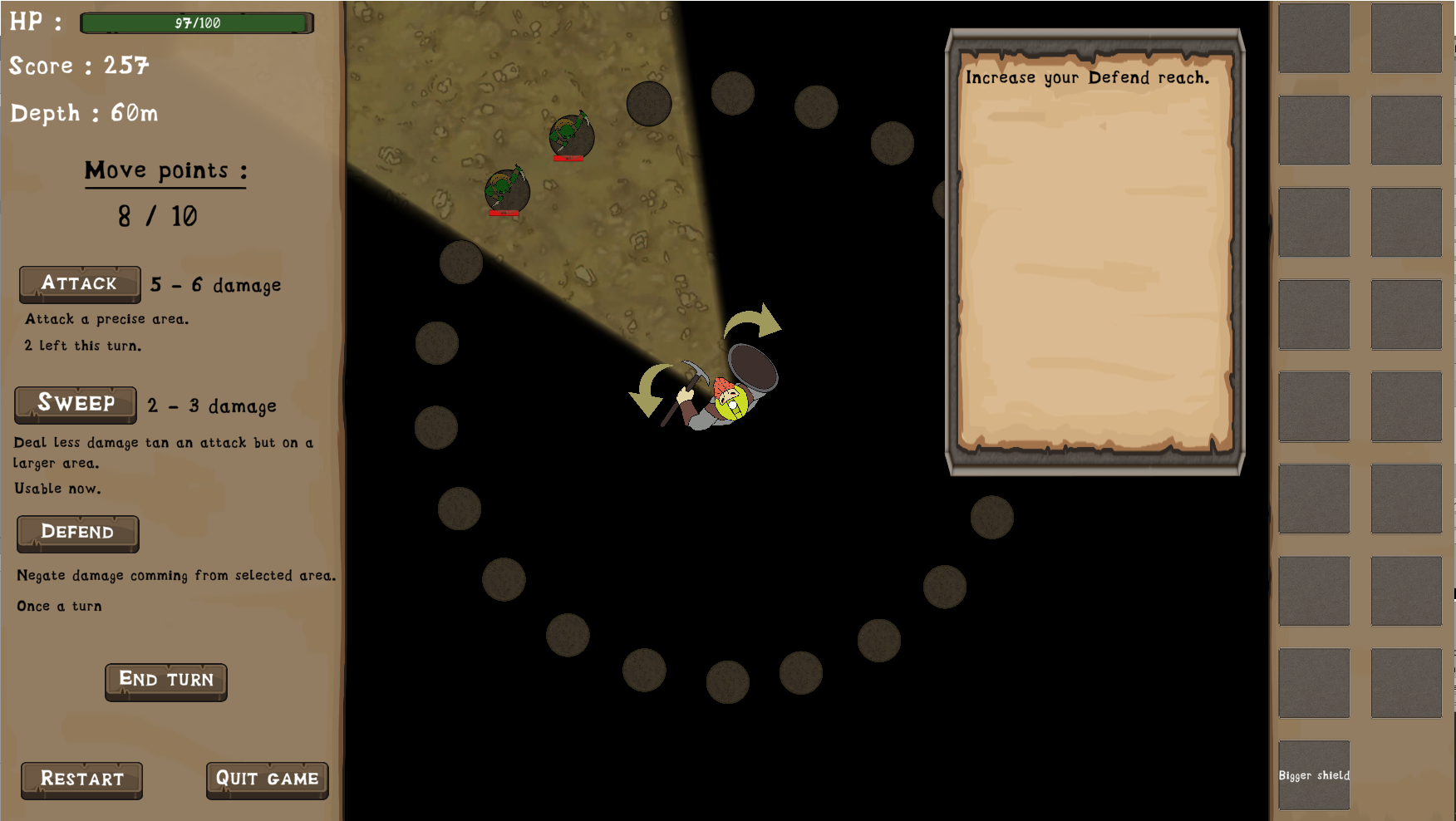
With the theme (and a song stuck in my head), I decided to draw on the imagery of dwarves. So, the game follows a dwarf descending into a mine. With this mine setting came the lighting mechanic, which became the foundation for developing the rest. I decided that depth would be a score, and the player must face a wave of enemies each time they go deeper. The enemies are positioned on a circle around the player at predetermined spots. The player can turn (which rotates their light), attack, or defend (within an arc). When an enemy takes action, it produces a sound represented visually at their location. This way, the player can roughly gauge the position of enemies even without light.
Gameplay screenshot
As a rogue-like, I also added an upgrade system. After completing a certain number of waves, the player earns an upgrade from a pool that enhances their abilities or grants new forms of action.
Conclusion :
Due to time constraints, numerous bugs remained in the game. Additionally, I feel that the theme was not fully utilized, mainly because the upgrades did not add enough depth. The gameplay quickly becomes repetitive and lacks variation.
However, it’s primarily a game jam project, made in a short time. Despite all its shortcomings, it could serve as a foundation for another game, and that’s the plan with the projet tourterelle.
This project was created during the Ludum Dare game jam, with the theme "Stuck in a Loop."
Process :
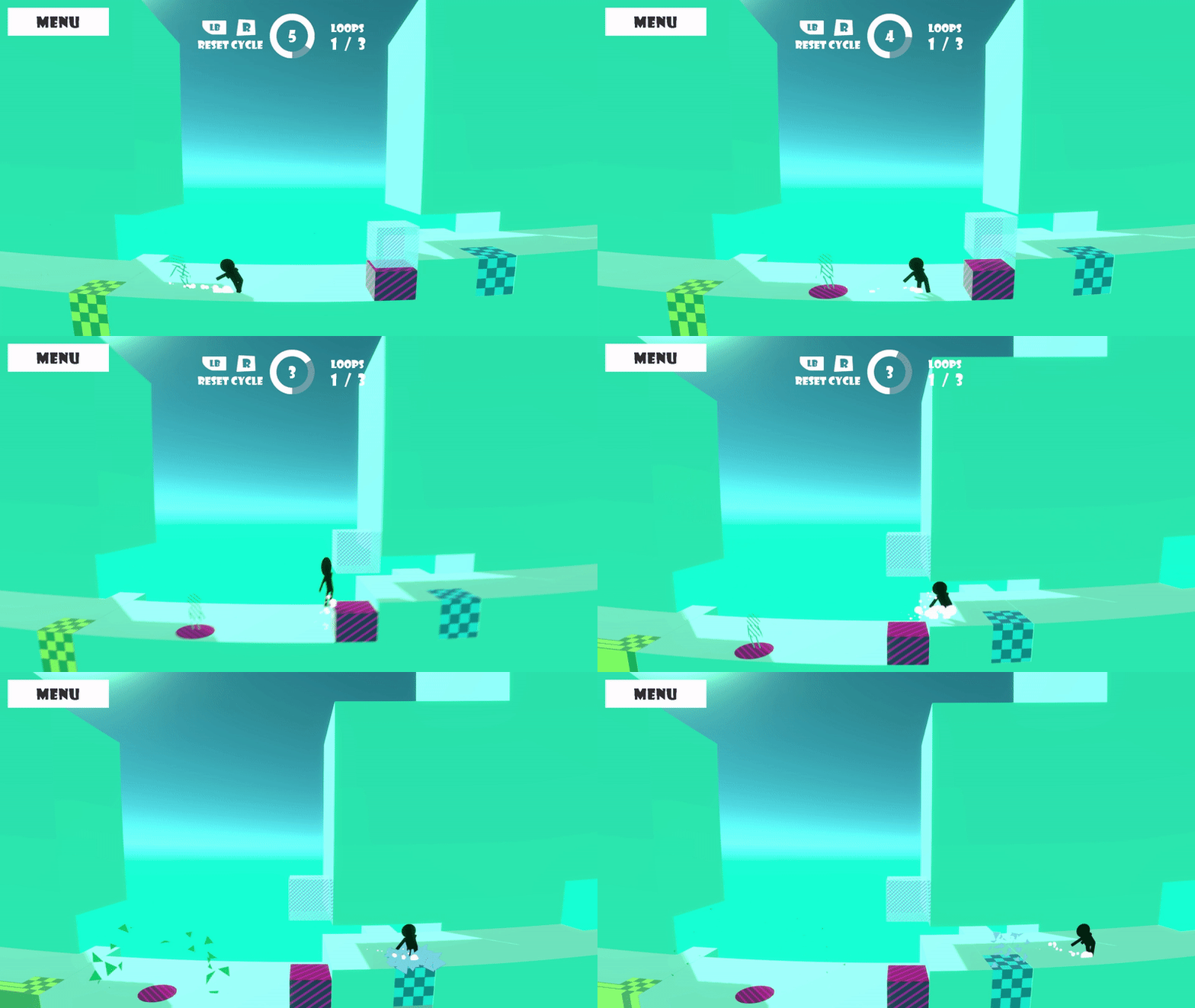
After a long brainstorming session, we settled on the game type and main mechanic: a puzzle-platformer with a time loop, where actions from previous loops are replayed.
From there, we defined the basic mechanics for our character, drawing on level design ideas, and decided to base some of our puzzles on physics.
Gameplay capture
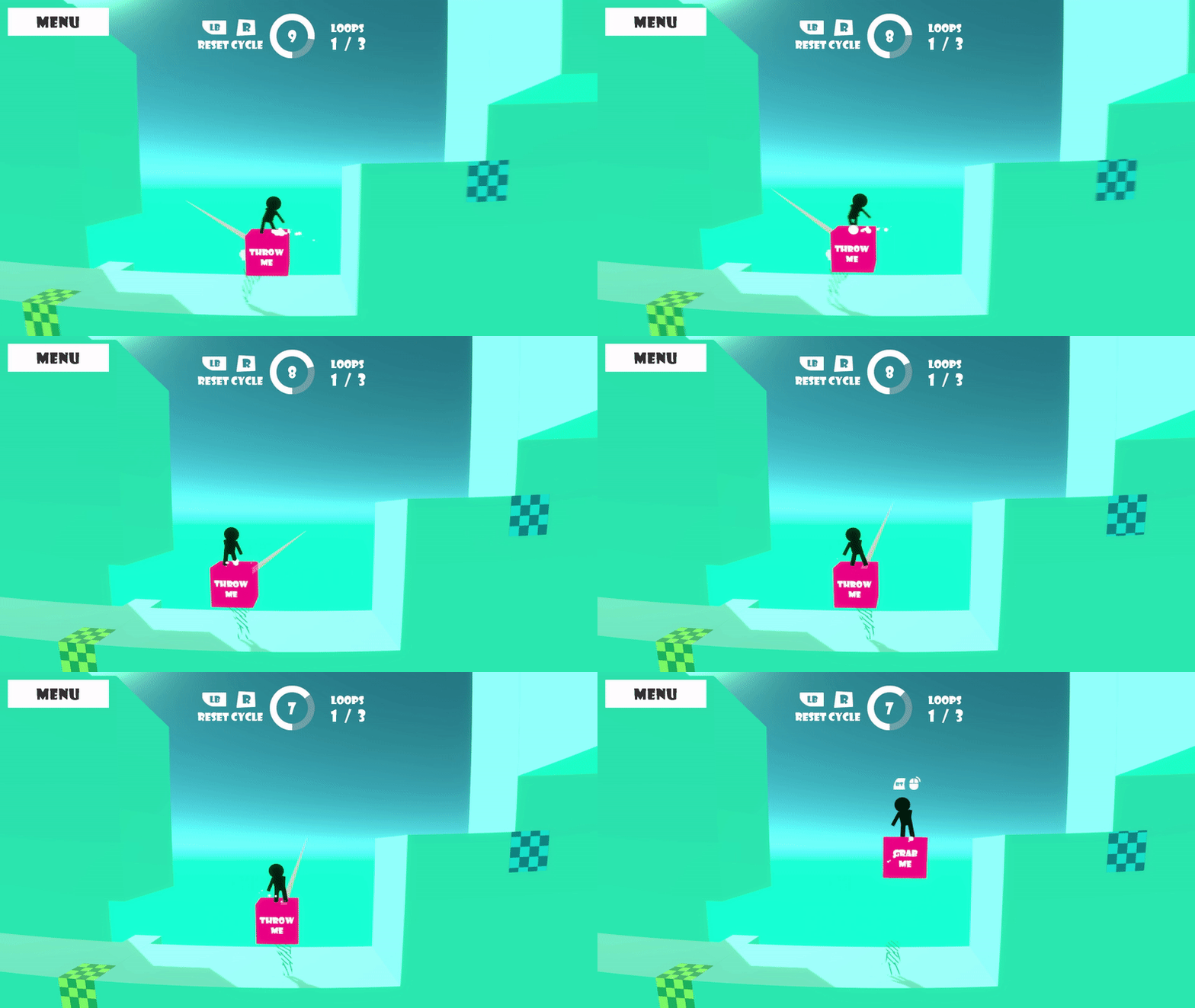
Once the basic mechanics were implemented, we focused on designing a few levels with simple concepts to serve as a demonstration for a potential complete game. A level editor was considered and even started to be developed but was not completed.
Gameplay capture
The main difficulty of this project (aside from finding a simple and effective system for the action buffer of the loops) was technical due to poor management of the Git repository, which broke a significant part of the project just 4 hours before the deadline, preventing us from integrating certain levels or elements like sound design.
Conclusion :
Although things went well at first, there was a lot of pressure towards the end, which fortunately did not prevent a release. A second version, corrected and with the modifications we hadn’t had time to integrate, was published on itch.io. There was a time when we considered continuing the project for a potential final version to be published on larger platforms like Steam, but due to a lack of free time on our part, that was canceled.
Neo vigrid :
Date : spetember 2018, during my Game design second year
This project was the first of my second year in Game Design during a dedicated workshop, where we had to create a board game themed around resurrection.
Prototype :
Once our team was assembled, we went through several brainstorming sessions without much success. We then spent an afternoon at Trollune (a board game store with a testing room) to playtest several board games. This helped us get into the right mindset, and we then chose to base our game around the theme of Ragnarok. We then decided on the narrative context: Ragnarok is cyclical, and the goal is to ensure the survival of your clan by paying a tribute in souls. To have an interesting visual identity, we opted for a futuristic/cyberpunk setting. We then tackled the mechanics with a focus on strategy.
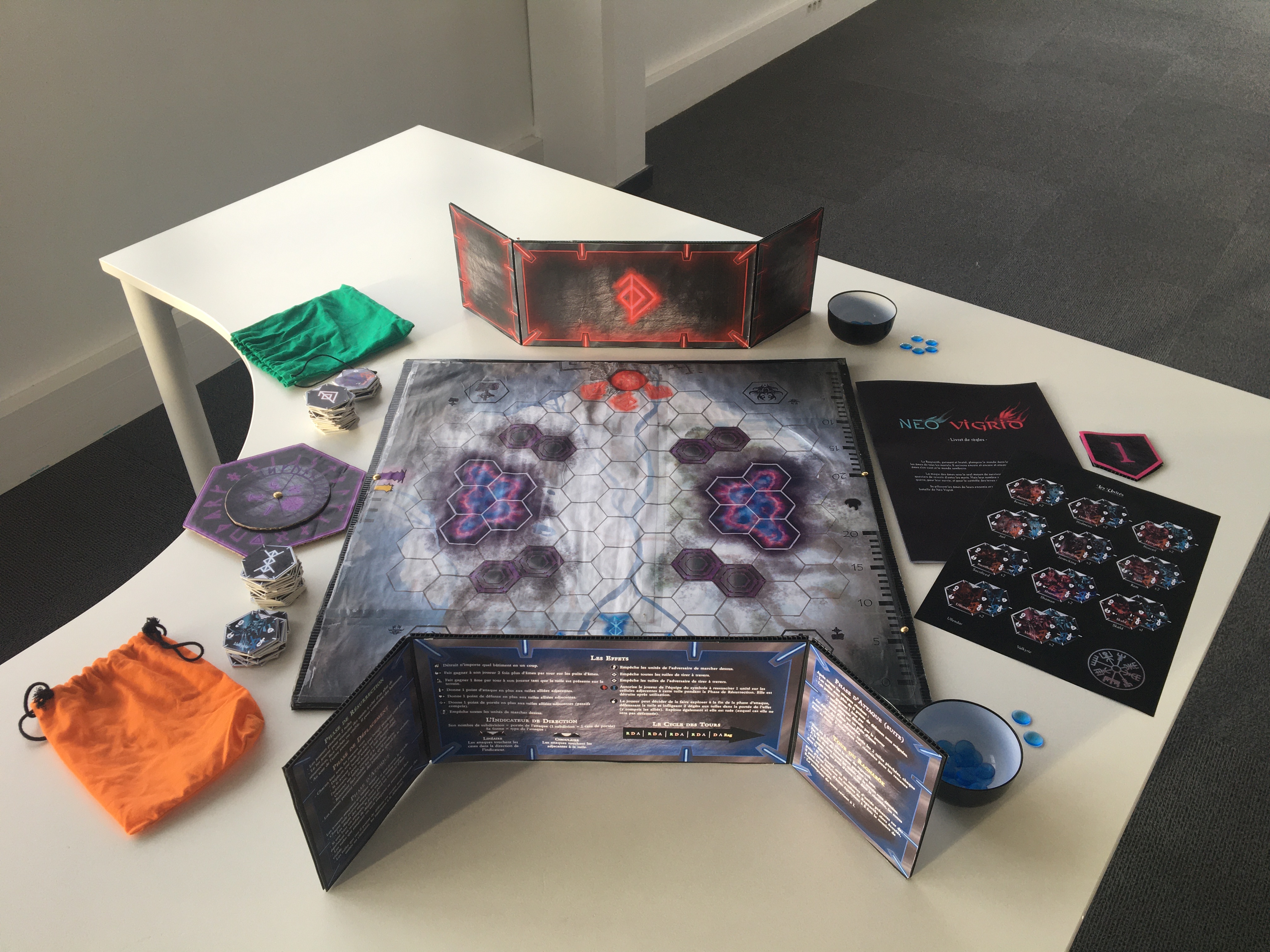
Final prototype
A turn proceeds as follows, with players taking their turn during each phase, and the first player changing each turn :
Resurrection phase : Players draw 2 tiles and can place up to 3 units next to their bases and as many buildings as they wish, as long as they are adjacent to a unit. Units can be placed face down or face up, knowing that once a unit is face up, it can no longer be hidden. If a player ends this phase with 0 souls, their gains will be doubled this turn.
Moving phase : Players move their units according to their movement values. They can always build, rotate their units, and reveal a unit.
Resolution phase : We resolve the attacks that the players decide simultaneously. Tiles taking damage equal to or greater than their defenses are sent to the graveyard (for units) or to the discard pile (for buildings), and hidden units attacking or being attacked are revealed. Tiles can attack the opposing base and cause the player to lose as many souls as the damage they deal. If it’s Ragnarok, all units are sent to the graveyard (if they are on a soul well) or to the discard pile. If a player has fewer units on the soul wells than the number of Ragnarok, they lose 5 souls. Players can then retrieve 3 tiles from their graveyards.
They were mentioned earlier, but players have souls. They start the game with 20 and lose them when they fall into the negative. Souls are used to place units.
Every 5 turns, Ragnarok strikes (at the end of the 5th turn).
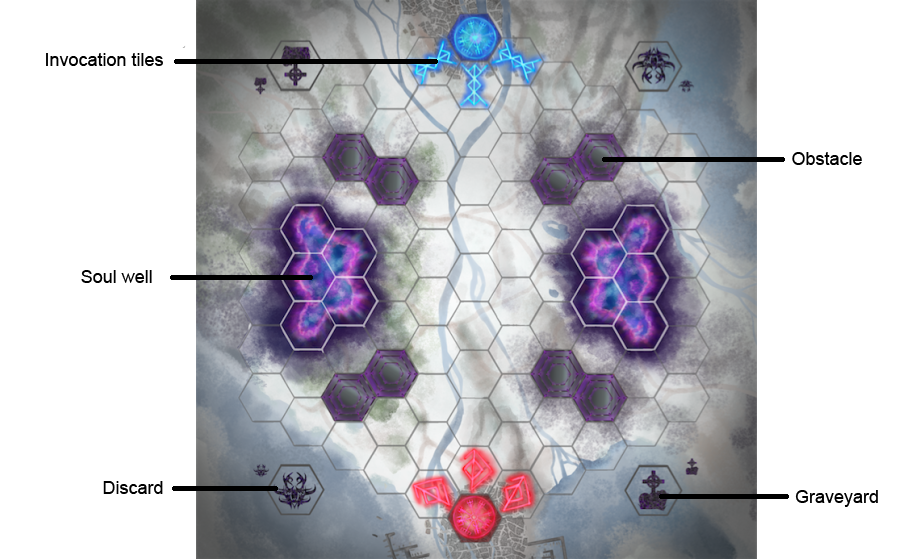
In terms of level design, the board is divided into hexagonal tiles (a choice made to avoid managing diagonals) and contains soul wells. The units present on these wells at the end of the turn grant 1 soul to their player. The objective is therefore to capture and hold these points while attempting to attack the enemy wells or base.
Labeled board
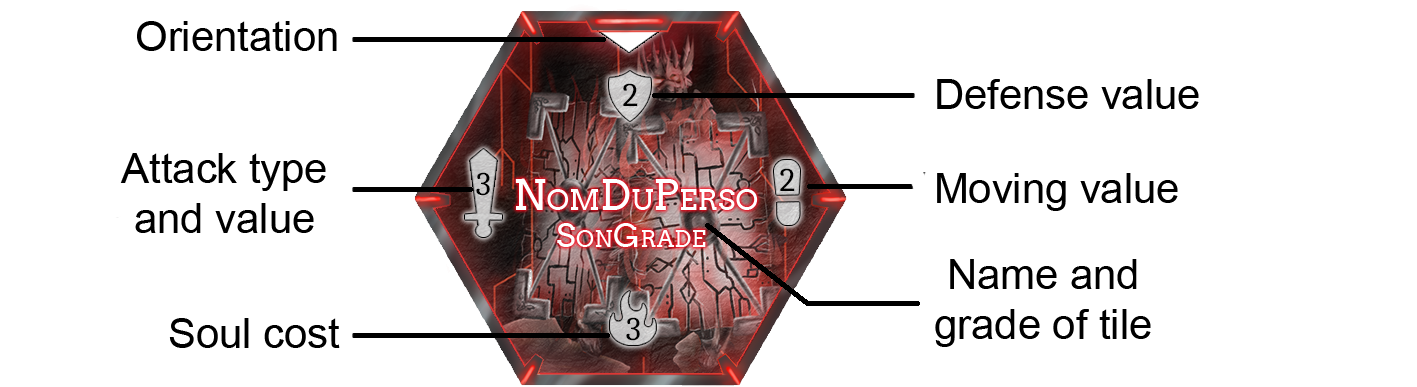
The tiles have various statistics: attack, defense, movement, a resurrection cost, and potentially effects such as a damage bonus to adjacent tiles or generating more souls at a point. Additionally, most tiles have an orientation that determines where they attack, while tiles without orientation can attack all around or have no attack capability.
Labeled tile
Conclusion :
We had several opportunities to gather feedback, the first being from the jury dedicated to the workshop. We presented the concept and played through a few rounds. The feedback focused mainly on user experience and some ambiguities in the rules. After this jury, we decided to move towards publication and incorporated the improvements suggested by them. Next, we had a professional from the industry, Xavier Lardy, playtest our game. He proposed additional enhancements and pointed out certain balance issues. He also provided numerous tips on communication to better explain the game. Later, we tested our game at Japan Haru 2019 and the Game Summit 2019, where we received more mixed feedback, particularly regarding the game’s length and some unclear terms. A primary takeaway was the lack of a "Viking" feel, as the gameplay centered mostly on holding positions.
However, players appreciated the tactical dimension of the game, the resource management, and the unique graphics.
We then began to explore numerous solutions to address these issues, ranging from making the Ragnarok more punishing to incentivizing aggression through resource gains. However, due to a lack of time with our studies and personal issues within the team, we decided to halt development.
This workshop took place during my third year and involved teaming up with first-year students to share our experience with them. The constraint was to create a simple battle royale concept.
Process :
We spent the first two days analyzing the genre, brainstorming, and defining our intentions. We wanted to:
The fluidity and movements from Titanfall.
The simplicity from PUGB
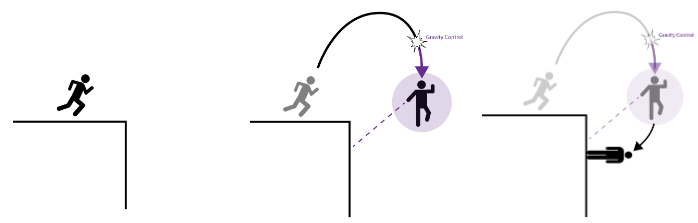
We then searched for the main mechanic that would allow us to stand out from the competition. We found gravity control. With this mechanic, we were able to lay the foundations for level design and the use of objects. This mecanic is thus divided into two phases :
The gravity phase is the "normal" phase where the player is affected by gravity.
In the control phase, the player gradually slows down until coming to a stop. During this entire phase, they can aim at a surface and, with the associated input, use that surface as a gravitational plane.
Gravity control overview
There are six gravitational planes, one for each side of the three orthonormal planes of space.
We defined that bullets would not be affected by gravity. However, usable objects (grenades, throwing knives, etc.) would follow the gravity of the launcher in real-time.
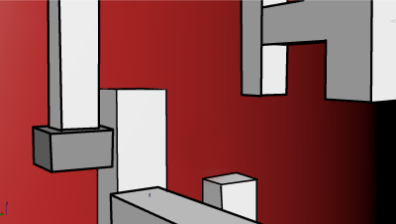
For the level design, we established a cylindrical map with buildings extending from both the top and bottom, along with numerous structures serving as bridges. Players will be dropped at the beginning of the game via a train that circles the cylinder. The walls of the structures and buildings will be aligned with the gravitational planes, making them very cubical (or block-like). To enhance player visibility, their angles will be outlined. Similar to other games in the genre, the playable area will gradually shrink throughout the match to force confrontations.
Oversimplified level design overview
Conclusion :
Although brief, this experience was incredibly stimulating, and we are proud of the concept we developed, which seems to have a lot of potential while remaining very simple. It also helped the first-year students grasp new concepts and the creation methodology.
Ludum dare 43 : Fusion cell
Date : 1-4 December 2018
Co-worker : Lucas Unty, Bastien Bernand, Benjamin Lapujade, Dylan Brousse, Victor Callot
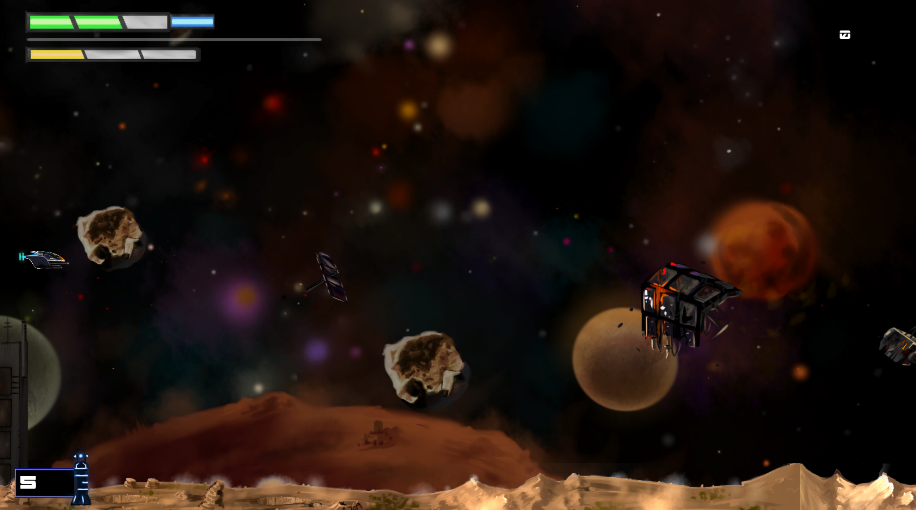
This project took place during the Ludum Dare game jam, themed "Sacrifice must be made." It was my first game jam (as it was for most of the others as well).
Process :
The theme inspired us very little, and the size of the team didn’t help us come to an agreement. Being our first game jam, our work was poorly distributed.
On this project, I worked on sound design and assisted with graphic production.
Overview
Conclusion :
There's not much to say about this project other than that it was difficult and exhausting. I was confronted with my limits in terms of organization and production, which allowed me to understand them better and work on myself.
It's not really a project I'm proud of, given its poor quality in terms of design. However, it allowed me to grow and set new goals for myself.
Current projects :
Project Manchot :
This is the project I'm currently working on the most. My goal is to publish it on Steam with a bridge to the Steam API to access the Steam Workshop. It's a relatively simple and small-scale project.
The goal is to create an obstacle course racing game against the clock (similar to Trackmania) where you control a bar of soap. This soap can move forward and turn, following the physics of sliding. Additionally, it has several turbo boosts per level that propel it forward at high speed. These features are currently implemented, and I am now working on enhancing the feeling of speed, incorporating numerous particle effects and post-processing effects.
The rest of the content will include level design elements such as ramps, surfaces, and other features. An important aspect of the game will be a level editor, allowing players to create and share their levels on the workshop. Additionally, once created, I can use it to build the game's levels, which will also give me the opportunity to conduct quality assurance.
Project Goéland :
It's a project I've been working on for a long time, but it's currently on hold. It's a rogue-lite RPG where players start by creating a character with randomly generated options and then embark on a top-down exploration session with turn-based combat. I want the game to be easily moddable so that players can add their personal touches. Originally, it was intended to be set in the Pathfinder universe, but after a few iterations, I began developing my own universe. Currently, some gameplay elements are in place and awaiting testing. I'm also considering the creation of a role-playing game.
Projet Tourterelle :
This project is the evolution of the Ludum Dare 48 and is currently on hold. The player will control a randomly generated team of dwarves (in the style of Rogue Legacy) and navigate a series of rooms (similar to Slay the Spire). The combat will be tactical, where managing light will be essential.